SunHawk Consulting and Couture Compliance Have Joined Forces



By Sarah M. Couture, RN, CHC, CHRC, and Brian D. Annulis, JD, MHA, CHC, CHPC
Originally Posted on: Compliance Cosmos
Since the inception of ClinicalTrials.gov, “a database of privately and publicly funded clinical studies conducted around the world,” in 2000,[1] the volume of registered clinical trials in the United States has skyrocketed. As of August 9, 2020, there were 115,883 active clinical trials in the United States.[2] Commensurate with the growth in registered clinical trials, there has been increased oversight and regulatory focus on clinical trials, including Common Rule updates,[3] billing compliance enforcement, scientific misconduct investigations, conflict of interest inquiries, and kickbacks and related enforcement actions, to name a few. As institutions pursue clinical research opportunities, whether industry sponsored or investigator initiated, it has never been more important for institutions to have solid administrative and operations processes to support their clinical research billing—what the authors of this article call research operations core (ROC) workstreams. Well-grounded processes not only help mitigate billing compliance risks, but also support efficient clinical research and contribute to the overall research strategy and financial success of the institution.
Our country is replete with world-class clinical research programs and brilliant scientists pursuing novel clinical discoveries and innovative treatments such as new drugs and medical devices. Behind the names and even potential fame and glory of these clinical research programs and investigators are the necessary administrative functions and staff that support them. While these ROC workstreams and staff may be far less flashy or recognized than the science or the scientists, they are the essential backbone of successful clinical research programs.
In many ways, the overall success of a clinical research enterprise rises and falls on the strength of its administrative support functions, including the research revenue cycle. While research leadership support, investigator commitment and passion, staff engagement, and patient participation are all essential, a clinical research program cannot realize its full potential—or ensure its regulatory compliance—without intentional focus; collaboration across silos; and active pursuit of excellence in clinical research operations, administration, and the revenue cycle. This article discusses some common pitfalls across the various ROC workstreams and identifies best practices to ensure billing compliance and to strengthen the efficiency and value of research operations. We organize those workstreams into pre-trial and post-study categories.
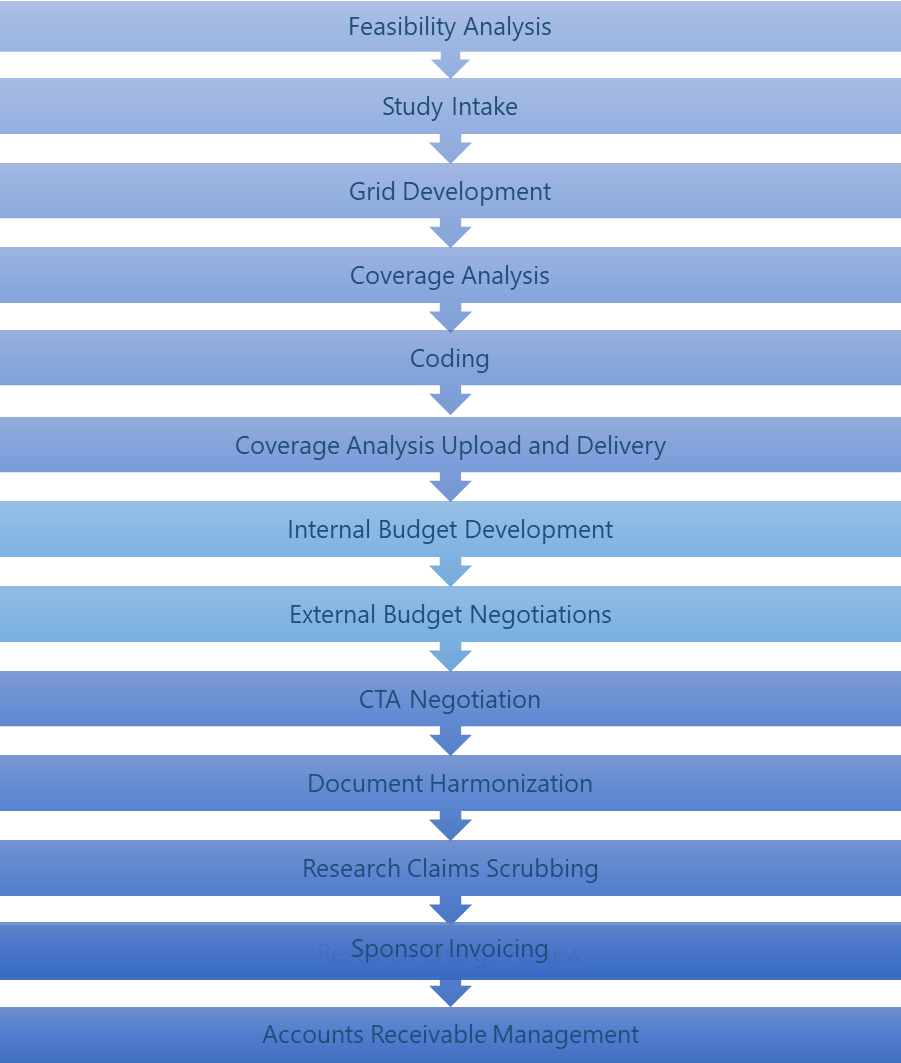
Many of the ROC workstreams, from feasibility analysis through document harmonization, occur primarily before the trial begins. In order to ensure appropriate billing and the best contract terms from sponsors, it is essential that these workstreams are coordinated and completed prior to enrolling the first subject. There will also be times during the trial that some of these workstreams may need to be revisited and updated to ensure continued accurate billing. For example, when the protocol or the budget is amended, the coverage analysis (CA), coding, and document harmonization would need to be updated to reflect the new protocol items or new payment terms.
While sponsors typically conduct a feasibility assessment for a proposed clinical study, research institutions do not always do so. As the clinical research landscape changes and financial margins decrease, research institutions should also consider whether the trial will be beneficial and aligned with its research portfolio and strategy.
A missing or insufficient feasibility assessment could lead to misalignment between the principal investigator (PI) and the institution, financial strain, stressed organizational resources and capabilities, and additional risk for the institution based on an insufficient study support structure.
Institutions with best practices have a documented and consistent feasibility analysis process that engages both the PI and research administration.
Study intake is the process of determining whether the study will proceed through the research revenue cycle processes (i.e., whether the study has any protocol-required items or services that could generate a charge). Successful study intake also entails gathering and reviewing all of the study documents (e.g., protocol, draft informed consent form [ICF], draft clinical trial agreement [CTA]/budget offer, any Food and Drug Administration or Medicare administrative contractor documents, etc.) and storing them in a consistent way.
Inadequate study intake processes can result in disorganized communication and missing study documents and can put the institution at risk of not identifying a study that requires a billing CA, which could lead to improper billing.
Institutions with best practices have a centralized process for collecting and storing study documents and evaluating whether the study has any items or services that could generate a charge.
Grid development is the first step in the CA and budget negotiation processes. A grid captures all protocol-required items and services and their frequency and timing. The finalized grid provides a framework of all items and services that will occur during the trial—critical for the CA and budget negotiations. Most grids are built either in Excel or a clinical trial management system.
An inaccurate or inadequate grid could result in erroneous billing or missed sponsor invoice opportunities. If not all items and services are captured, the missed items/services could either be billed to the payer/patient when they should not have been, or the institution could miss out on the opportunity to negotiate payment for that item/service from the sponsor.
Institutions with best practices devote sufficient resources and develop standard processes in order to develop grids that accurately capture all study activities and their frequency.
A CA is a systematic approachto determine what, if any, charges in a study may be billable to a third-party payer according to National Coverage Determination (NCD) 310.1 and various regulations for device studies. The CA is built on the billing grid. The NCD 310.1 allows billing for certain items and services that meet the definition of “routine costs” that occur during a “qualifying clinical trial” when no other Medicare rule precludes billing.[4] Medicare standards are typically used when determining research study coverage, as Medicare has the most developed framework, most payers follow the lead of Medicare, and the consequences for billing errors are the most significant with Medicare.
An inadequate CA can lead to billing risks, including potential False Claims Act liability. The risks include:
Institutions with best practices develop consistent processes for determining what items and services in a clinical research study may be billable to the patient or third-party payer. The CA not only guides billing during the study, but also helps the institution negotiate a budget with the sponsor by requesting the sponsor pay for items/services for which the institution cannot bill.
Once the CA is performed, the next step in the clinical research billing process is coding the items and services on the calendar grid for future billing purposes. The coding workstream involves having certified outpatient coders apply Current Procedural Terminology and Healthcare Common Procedure Coding System codes to the service lines on the calendar grid.
Once the draft CA is complete, it is uploaded to the clinical trial management system, if used by the institution, and provided to the PI and study team for review and approval. Delivery should involve collaboration between the research revenue cycle and the PI/study team, as the PI can lend expertise and provide supporting documentation that the analysis team may not have been able to locate.
If the CA is finalized without collaboration with the study team, it is at risk of inaccuracy, as the PI is often the subject matter expert and can shed light on areas of the CA that may seem vague to the research revenue cycle.
Institutions with best practices have a collaborative CA delivery process that involves an open and ongoing dialogue between the CA and the study teams.
Internal budget development helps the institution estimate the total costs involved with participating in the study. The internal budget includes not only the cost of all the protocol-required items and services, as outlined in the CA, but also the various administrative costs incurred in the pursuit of the research. An internal clinical trial budget helps ensure the financial viability of the study. It also serves as the basis for sponsor negotiations, since it captures all study costs and can serve as a future audit tool. A consistent process for internal budget development can also help the institution negotiate acceptable budgets across other studies with the same sponsor and can ensure documentation and justification of costs in case of future audit.
The success of the internal budget is based on its attention to detail and its ability to capture all potential costs associated with the study. The primary pitfall of internal budget development is failure to account for all costs. Failing to or inaccurately capturing study-related costs will hamper the success of external budget development and sponsor negotiations and can result in decreased financial solvency of the study and the institution’s research program.
Institutions with best practices understand the importance of capturing all study-related costs and building a foundation for external budget negotiations. These institutions also use consistent processes and templates to establish a precedent for future study negotiations and help the organization anticipate research revenue, instead of accepting initial sponsor offers or sacrificing future negotiations to gain approval for the study at hand.
The goal of external budget negotiations is to get the maximum amount of financial support from the sponsor for the institution’s participation in the study. Favorable negotiations result in research programs that are positive contributors to the institution’s financial well-being.
Without solid external budget negotiations processes, the institution will likely not get maximum financial support from the sponsor, resulting in lower research revenues and an overall weaker research infrastructure.
Institutions with best practices have mature external budget negotiation processes that work toward maximizing the remuneration associated with the cost per patient, as well as the administrative, start-up, and overhead fees for which the sponsor should be expected to pay.
CTAs are the contracts that bind parties in the context of a clinical trial. The parties involved include the institution(s) and the sponsor, and sometimes the PI.
An uninformed CTA negotiations process leads to unfavorable assignment of risks and disadvantageous delegation of costs and responsibilities.
Institutions with best practices understand their risk profile, consider obligations to their stakeholders, and examine all relevant issues, but they focus primarily on high-risk issues to balance the clinical trial risks and costs with the timeline constraints of contract negotiations.
Document harmonization is the process of harmonizing or syncing the final study documents, including the approved ICF and executed CTA or grant (and associated budget) with the draft CA. This prepares the CA to be used for billing and ensures that the CA accounts for any items or services promised free to the patient or paid by the sponsor or grant.
Institutions with no such harmonization expose themselves to risk, as the CA that will be used to guide billing may not incorporate the final financial terms described in the final study documents. Accurate interpretation of the final study documents’ billing language is also essential, as billing a service promised free or where sponsor/grant payment is promised can result in False Claims Act violations and subject the institution to penalties and sanctions.
Institutions with best practices have a workflow that ensures the draft CA is finalized by syncing it with the final study documents before it is used for billing.
The following ROC workstreams occur after the trial has commenced and continue throughout the life of the trial. Recouping the institution’s labor and financial investment in the pre-trial workstreams requires the institution to ensure that the post-study commencement workstreams are also properly attended to.
Research claims scrubbing is the process of ensuring charges for items and services performed for study purposes are routed to the accurate party (e.g., payer or sponsor).
Inconsistent research claims scrubbing can result in charges being routed incorrectly to the wrong party, resulting in double billing or other billing errors.
Institutions with best practices develop methods to review research charges and confirm accuracy before billing.
Hand in hand with research claims scrubbing is sponsor invoicing. Sponsor invoicing is the process by which the institution bills the sponsor for study-related services as reflected in the negotiated budget. Sponsor invoicing unifies the business and clinical sides of study services by coupling administrative data, such as the subject’s name, insurance provider for non-study–related services, and other personal information, with the treatment the subject receives.
If charges cannot be appropriately identified, segregated, and then billed, items and services that will be paid by the sponsor may be billed instead to Medicare, resulting in double billing and putting the institution at risk for False Claims Act violations.
Institutions with best practices have tight processes across the research revenue cycle to ensure the right charges and administrative fees are billed to the sponsor in a timely manner.
Accounts receivable (AR) management reflects the money owed to the provider for services rendered, billed, and not yet collected. This addresses both research claims scrubbing and sponsor invoicing. Payments due from patients, payers, sponsors, or other guarantors are considered AR. Efficient AR management maximizes revenue potential, ensuring cash flow is sufficient for effective study department management.
Without appropriate AR management, study departments may not have enough cash to operate or may have negative credit balances. This would diminish the long-term viability of the department’s research operation and may affect the overall sustainability of the institution’s research program.
Institutions with best practices have processes in place to manage AR and ensure it gets paid correctly and in a timely manner.
The ROC workstream issues, pitfalls, and compliance tips described above should provide the reader a road map for developing sound and compliant clinical research billing processes. Other factors will influence an institution’s research program success, including leadership’s understanding and commitment of resources, research strategy, centralization or decentralization of research operations, the relationship between research administration and study teams, engagement of research operations with PIs, data and technical infrastructure, experiences of team, culture, etc. That said, with collaboration and communication, engagement of PIs and study teams, development of consistent processes, and accountability and auditing, your research operations core can be ROC-solid and operate efficiently, contributing to an industry-best and vibrant clinical research program.
1 “Home,” ClinicalTrials.gov, United States National Library of Medicine, National Institutes of Health, last accessed August 6, 2020, https://bit.ly/3kfTO5v.
2 “Trends, Charts, and Maps,” ClinicalTrials.gov, United States National Library of Medicine, National Institutes of Health, last accessed August 6, 2020, https://bit.ly/33yOZhB.
3 “Revised Common Rule,” Office for Human Research Protections, U.S. Department of Health & Human Services, last reviewed January 19, 2017, https://bit.ly/3ictMy7.
4 “National Coverage Determination (NCD) for Routine Costs in Clinical Trials (310.1),” Centers for Medicare & Medicaid Services, last accessed August 6, 2020, https://go.cms.gov/3cDQqx7.
Copyright 2023 Compliance Today, a publication of the Health Care Compliance Association (HCCA)
